MB Crusher buckets enable on-site aggregateproduction for challenging hill road projects in North India.
Road construction contractors operatingin hilly and remote regions of North India are increasingly shifting to on-sitecrushing to control costs, timelines, and logistics. Recent road infrastructureprojects executed in the Himalayan belt demonstrate how excavator-mountedcrushing solutions are addressing long-standing operational challenges faced inmountainous terrain.
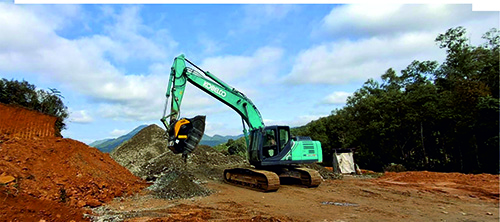
On multiple road construction packagesacross northern hill states, contractors deployed the MB Crusher BF90.3 jawcrusher bucket on 20–23 tonne class excavators to produce aggregates directlyat site. The projects involved road alignments ranging from 19 to 26 km, withmaterial volumes exceeding 30,000 cubic meters, primarily comprising hard hillrock and mixed mountain rubble.
Hill road projects in North India facea unique mix of constraints. Static crushing plants are often located 25–30 kmaway from project sites, connected through narrow, winding roads with load andmovement restrictions.
Transporting aggregates under theseconditions leads to high diesel consumption, frequent breakdowns, and scheduleuncertainty. In several locations, contractors purchased aggregates at pricestouching INR1,400 per cubic meter, excluding transport risk and delays.
Attempts to use small on-site crushersor mobile plants has often proven to be inefficient. Frequent choking, lowthroughput on hard rock, additional manpower requirements, and limited workingspace made conventional solutions difficult to sustain.
On-SiteCrushing approach
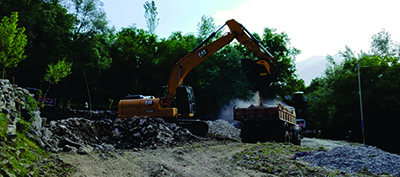
To overcome these challenges,contractors integrated the MB BF90.3 crusher bucket with their existingexcavator fleets, including CAT, Komatsu, and Kobelco machines. The attachmentwas configured to process 250–300 mm hill rock and produce GSB-compliant outputsizes below 50–60 mm, suitable for sub-base and road-layer applications.
Installation required no civilfoundation or permanent setup. Operators were trained on feed control and jawadjustment, allowing the attachment to be commissioned within days.
Operationalperformance
The crusher buckets operatedcontinuously as the road alignment progressed, eliminating the need foraggregate transportation from distant plants. Key operational outcomes observedacross the sites included:
- Complete elimination of aggregate haulage from externalcrushers.
- Significant reduction in diesel consumption linked totransport.
- Lower manpower deployment, with a single excavator operatormanaging crushing.
- High equipment uptime with minimal stoppages.
- Consistent material availability supporting uninterruptedroad works.
In comparative terms, every cubic meterof aggregate produced on-site replaced purchased material, resulting insubstantial cost avoidance over the project lifecycle. Contractors indicatedthat the attachment investment was effectively recovered within the sameproject duration.
Businessimpact
The shift to attachment-based crushingdelivered direct business benefits. Contractors achieved tighter cost control,reduced dependency on external suppliers, and improved predictability inexecution schedules. Equipment utilization improved as excavators performeddual roles, and projects aligned better with environmental and C&D materialreuse expectations increasingly emphasized in public infrastructure works.
For road projects in remote orsensitive regions, the approach also reduced traffic movement and sitecongestion, supporting safer and more compliant operations.
Marketinsight
These projects underline a clear trendin Indian hill infrastructure development: on-site aggregate production usingexcavator-mounted crusher buckets is emerging as a practical alternative tofixed or mobile plants. For contractors working in terrain-constrainedenvironments, this model offers flexibility, faster mobilization, and strongercontrol over project economics.
As road connectivity programs expandinto remote geographies, attachment-based crushing is likely to play a growingrole in how contractors plan material processing on site.